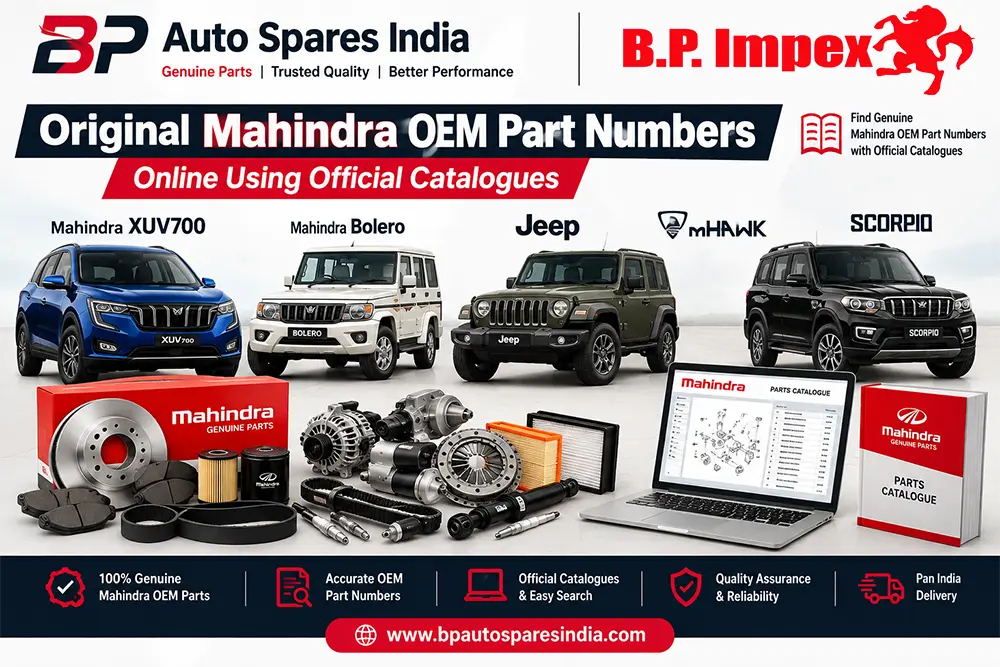
Finding the right part in an official Mahindra OEM spare parts catalogue shouldn’t feel like a guessing game. A single wrong digit in a part code can lead to buying an incompatible component, wasting both time and money. In this step-by-step guide, you will learn how to navigate electronic catalogues, decode 10-digit part numbers using your VIN, and verify authentic packaging before making a purchase.
If you own or repair a Mahindra vehicle, you have likely faced the headache of receiving a spare part that turns out to be a few millimeters off or designed for a different model year.
Buying automotive spare parts online can be tricky. A single incorrect digit in a part number can lead to buying an incompatible component, wasting both time and money.
Whether you are looking for Mahindra Bolero spare parts for a commercial fleet or sourcing specialized mHawk Engine spare parts for a major overhaul, this guide explains how to read parts catalogues, decode part numbers, and verify authenticity before making a purchase.
The Common Pitfall: Why Model Names Aren’t Enough
When ordering spare parts online, searching simply by vehicle name—such as looking for Mahindra Jeep spare parts—often leads to wrong orders.
Mahindra frequently updates internal components during minor mid-year revisions without changing the exterior body shape. For example:
- Suspension bushes and brake disc thicknesses vary across production years.
- Sensor wiring harnesses differ depending on whether the vehicle is equipped with manual or automatic transmission.
- Fuel injection pressures and injector nozzles vary depending on engine output tuning.
To get the right part every time, you need the exact 10-digit OEM (Original Equipment Manufacturer) part number rather than relying only on the model name.
How to Read Mahindra Electronic Parts Catalogues (EPC)
An Electronic Parts Catalogue (EPC) displays exploded view diagrams (schematics) showing how every nut, bolt, washer, and mechanical assembly fits together.
+———————————————————————————–+
| TYPICAL EPC CATLOGUE FLOW |
| |
| [Select Vehicle Model] –> [Choose Main System] –> [Select Sub-Assembly] |
| (e.g., Scorpio Classic) (e.g., Drivetrain) (e.g., Rear Axle & Hubs) |
| |
| | |
| v |
| [Inspect Exploded View Schematic] |
| | |
| v |
| [Click Component for 10-Digit OEM Code] |
+———————————————————————————–+
Understanding the Part Numbering Format
Mahindra part numbers generally follow a structured alphanumeric layout:
- Platform / Series Code (First 3–4 Digits): Identifies the core chassis family.
- Category Code (Middle Digits): Denotes the functional group (e.g., ENG for Engine, SUS for Suspension, ELE for Electrical).
- Variant Identifier (Final Digits): Indicates structural revisions, material upgrades, or left-hand/right-hand orientation.
Step-by-Step: Finding Your Exact Part Number Online
Step 1: Locate Your 17-Digit VIN (Chassis Number)
Your Vehicle Identification Number (VIN) contains the exact manufacturing year, plant code, engine code, and trim level.
- Where to find it: Stamped on the metal plate in the engine bay, on your vehicle registration certificate (RC), or on the driver-side door pillar.
Step 2: Use Verified Online Portals
Instead of generic Google searches, use structured databases:
- Mahindra With You Hamesha App/Portal: Useful for checking service schedules and part numbers associated with past workshop repairs.
- Reputable Parts Portals (e.g., Boodmo, BP Impex, Partsmith): These platforms host interactive exploded diagrams where entering your VIN automatically filters out non-matching components.
Step 3: Match the Exploded Diagram Item Number
Open the correct category (e.g., Front Suspension and Steering), locate your part in the diagram, and find the full 10-digit OEM code listed in the index table. Click here to find Mahindra OEM part numbers.
Model-Specific Sourcing Guidelines
Different models require attention to different high-wear components. Here is what to watch out for when looking up parts for specific platforms:
1. Modern SUVs & High-Tech Systems
When searching for Mahindra XUV700 spare parts, electronic compatibility is as critical as mechanical fitment.
- Key Components: Frequency Selective Damping (FSD) shock absorbers, Electronic Parking Brake (EPB) rear brake pads, and ADAS radar/camera wiring harnesses.
- Watch Out For: Trim levels (MX vs. AX7) use completely different electrical harnesses and sensor calibration specs.
2. Ladder-Frame & 4WD Vehicles
If you are sourcing Mahindra Scorpio Classic/N spare parts, pay close attention to generational updates between the older chassis layout and the modern platform.
- Key Components: Dual-mass flywheels (DMF), prop-shaft universal joints, rear link suspension bushings, and 4XPLOR transfer case actuators.
- Watch Out For: Front brake calipers and hub assemblies differ between the Scorpio Classic and Scorpio-N, even when engine capacities look identical on paper.
3. Utility Vehicles & Workhorses
Heavy-duty utility platforms rely on simple, high-durability hardware designed for load-carrying. When ordering Mahindra Bolero spare parts, focus on chassis load ratings.
- Key Components: Polyurethane leaf spring bushes, shackle pins, heavy-duty brake drums, and steering ball joints.
- Watch Out For: Commercial variants (like the Pik-Up) share engine components with passenger variants, but use different rear axle gear ratios and brake drum diameters.
4. Rugged Off-Road Rigs
When maintaining off-road vehicles or sourcing Mahindra Jeep spare parts, focus on components that endure high torsional stress and water exposure.
- Key Components: Differential lock mechanisms, transfer case shift linkages, heavy-duty drive shafts, and weather-sealed soft-top latches.
- Watch Out For: Petrol and diesel variants use different front spring rates due to engine weight differences.
5. Common-Rail Diesel Engines
When sourcing mHawk Engine spare parts, matching part numbers precisely is critical to protect your fuel system and turbocharger.
- Key Components: Common Rail Direct Injection (CRDI) fuel injectors, high-pressure fuel pumps, Variable Geometry Turbochargers (VGT), and timing chain kits.
- Watch Out For: The mHawk engine comes in multiple power outputs (e.g., 120 bhp, 140 bhp, 172 bhp, 182 bhp). A fuel injector designed for a lower-output tune will cause poor combustion and engine error codes if installed in a high-output variant.
How to Spot Fake vs. Genuine OEM Parts Upon Delivery
Once your ordered part arrives, verify its authenticity before installation:
- Check the Tamper-Evident Hologram: Authentic Mahindra packaging features a security hologram that changes color and reveals hidden patterns under light.
- Scan the Authentication QR Code: Use your smartphone camera to scan the box QR code. It should direct you to an official validation page showing matching part descriptions and batch numbers.
- Inspect Physical Markings: Metal castings (such as control arms, manifolds, and brake discs) often have the official brand logo or 10-digit part code stamped directly into the metal body. Online Mahindra OEM Catalogue
Final Checklist Before Placing an Order
- Have you entered your full 17-digit VIN into the catalogue search?
- Does the part description match your vehicle’s exact fuel type and transmission?
- Have you cross-checked engine output ratings for fuel and turbo components?
- Are you buying from an authorized distributor or trusted portal with a clear return policy?
Conclusion
Finding the right spare part online doesn’t have to be a guessing game. By shifting your approach from generic model searches to using exact 10-digit OEM part numbers, you eliminate the risk of receiving mismatched components.
Whether you are performing routine maintenance on a Mahindra XUV700, replacing heavy-duty suspension bushes on a Mahindra Bolero, upgrading off-road drivetrain components with authentic Mahindra Jeep spare parts, or overhauling high-pressure fuel systems with genuine mHawk Engine spare parts and Mahindra Scorpio Classic/N spare parts, taking a few extra minutes to cross-reference your 17-digit VIN against an official exploded diagram will save you time, money, and hassle in the long run.




Leave a Reply