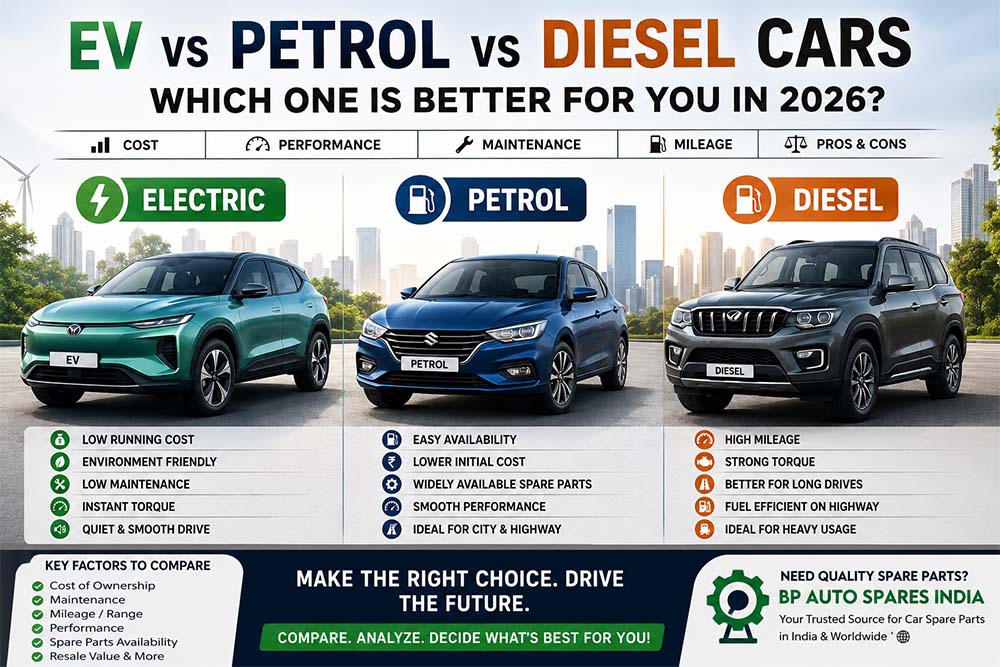
You are standing in a car showroom with three options in front of you.
One car is electric. It promises low running costs, silent performance and fewer mechanical components. Another is petrol-powered, familiar, convenient and easy to refuel almost anywhere. The third is a diesel, offering strong torque and impressive highway efficiency.
All three salespeople have a convincing argument.
The EV salesperson talks about saving money on fuel. The petrol salesperson talks about convenience and lower upfront cost. The diesel salesperson points toward long-distance efficiency and torque.
So, who is actually right?
The answer is surprisingly simple: none of them is automatically right for everyone.
The best car in 2026 depends on how you drive, how much you drive, where you live, how you plan to maintain the vehicle and how long you intend to keep it.
An electric car can be an excellent financial decision for someone driving through city traffic every day with access to home charging. The same EV may become inconvenient for someone who regularly travels long distances through areas where charging infrastructure is limited.
A petrol car may cost more to run over several years, but its convenience, refuelling speed and widespread service network can make it the better choice for another buyer.
And diesel? Despite the industry’s shift toward electrification, diesel has not suddenly become irrelevant. For certain high-mileage and highway users, it can still make practical sense.
That is why this EV vs Petrol vs Diesel comparison for 2026 is not going to tell you that one technology is universally superior.
Instead, we are going to look at what actually matters after the excitement of buying a new car is over:
Purchase cost. Running cost. Mileage. Performance. Maintenance. Spare parts. Charging. Refuelling. Resale value. Reliability. And long-term ownership.
By the end, you should be able to look at your own driving habits and answer a much more useful question:
Which car makes the most sense for me?
EV vs Petrol vs Diesel: The Automobile Market Is Changing
The traditional petrol-versus-diesel debate has been around for decades.
Electric vehicles have changed that conversation.
India’s automobile market is gradually moving toward electrification, but this does not mean petrol and diesel vehicles have disappeared. In fact, buyers still have a wide variety of choices across all three powertrain technologies.
Passenger vehicles are becoming more sophisticated, fuel-efficiency expectations are increasing, safety standards are evolving and buyers are paying greater attention to the total cost of ownership rather than just the showroom price.
That last point is particularly important.
A car advertised as cheaper to buy may not necessarily be cheaper to own.
Imagine two cars:
Car A costs less at the dealership but consumes considerably more fuel.
Car B costs more initially but has a much lower energy cost and requires less routine maintenance.
If you plan to keep the vehicle for seven years, which one is actually cheaper?
That is where the real EV vs petrol vs diesel debate begins.
What Is the Difference Between an EV, Petrol and Diesel Car?
Before talking about prices, mileage or maintenance, let’s understand what is happening underneath the bonnet—or, in the case of an EV, under the floor.
How an Electric Car Works
An electric vehicle stores electrical energy in a high-voltage battery pack.
That electricity is controlled by electronic systems and supplied to an electric motor, which turns the wheels.
A typical EV powertrain includes:
- High-voltage battery
- Electric motor
- Inverter
- Battery Management System
- On-board charger
- DC/DC converter
- Reduction gear
- Thermal-management system
- Charging port
- Electronic control units
One of the biggest differences is the number of moving components.
A conventional engine contains numerous mechanical parts working together thousands of times every minute. An electric motor has a much simpler mechanical arrangement.
That simplicity has an important consequence:
There are fewer engine-related components that require regular servicing.
But there is an important catch.
An EV is not maintenance-free.
Tyres, brakes, suspension, steering components, air conditioning, 12V batteries, cooling systems and electronics still require attention.
And when something goes wrong with a high-voltage system, the repair normally requires trained technicians and appropriate diagnostic equipment.
How a Petrol Car Works
A petrol car uses an internal-combustion engine.
Air and fuel enter the engine, the mixture is compressed and ignited using a spark. The resulting combustion pushes the pistons, turning the crankshaft and ultimately driving the wheels through the transmission.
This involves many components, including:
- Engine
- Pistons
- Crankshaft
- Camshaft
- Spark plugs
- Fuel injectors
- Fuel pump
- Air filter
- Oil filter
- Cooling system
- Exhaust system
- Transmission
- Sensors
- Electronic control modules
Petrol engines have been refined for generations, which is one reason they remain so popular.
There is also a huge ecosystem of mechanics, service centres and replacement-part suppliers supporting petrol vehicles.
How a Diesel Car Works
A diesel engine also burns fuel inside the engine, but its combustion process is different from that of a petrol engine.
Diesel engines typically use compression ignition and are designed to produce strong torque, particularly at low and medium engine speeds.
This characteristic has historically made diesel vehicles popular among:
- Highway drivers
- High-mileage users
- Larger vehicle owners
- Commercial users
- Drivers who regularly carry heavy loads
Modern diesel engines, however, are significantly more sophisticated than older-generation diesels.
Emission-control systems, turbochargers, high-pressure fuel injection and other technologies have improved performance and emissions but have also increased mechanical complexity.
That means modern diesel ownership requires proper maintenance rather than simply relying on the old idea that “diesel engines last forever.”
EV vs Petrol vs Diesel: Which One Costs More to Buy?
Let’s start with the cost that is easiest to understand: the purchase price.
But even here, there is a trap.
Many buyers compare the cheapest EV with a petrol car, or a diesel SUV with a smaller petrol hatchback, and then draw conclusions about which technology is cheaper.
That is not a fair comparison.
A better comparison is between vehicles with similar:
- Size
- Features
- Safety equipment
- Performance
- Battery/engine capacity
- Technology
- Seating capacity
Only then can you understand whether one powertrain genuinely costs more.
Why EVs Can Have a Higher Initial Price
The battery is one of the most expensive components of an electric vehicle.
An EV effectively carries a large energy-storage system with it everywhere it goes.
That adds considerable manufacturing cost.
However, the higher initial price does not tell the complete story.
If an EV owner drives a large number of kilometres every month, the lower energy cost can gradually compensate for the initial price difference.
This is known as the break-even point.
For example, imagine:
- Petrol car costs 10 lakh
- Comparable EV costs 13 lakh
The EV costs 3 lakh more upfront.
If the EV saves 6,000 every month in energy and maintenance costs, that difference could theoretically take around 50 months to recover.
This is only an illustration, not a universal calculation. Actual savings depend on electricity rates, petrol prices, efficiency, annual kilometres, charging losses, servicing and the vehicles being compared.
But the concept is extremely important.
Never judge an EV only by its showroom price.
Petrol Cars: The Familiar Middle Ground
Petrol vehicles generally have a strong advantage when it comes to choice.
From compact hatchbacks to premium SUVs, buyers can find petrol models across a huge range of budgets.
They also offer something EV buyers sometimes have to plan around:
Five minutes at a fuel station can add hundreds of kilometres of usable range.
There is no need to wait for a battery to charge.
For someone who frequently changes plans or travels without a fixed route, that flexibility has genuine value.
Petrol cars also benefit from a mature service ecosystem.
Most towns and cities have technicians who understand petrol engines, and replacement components are widely available.
This makes petrol particularly attractive for buyers who want predictable ownership without changing their daily routine.
Diesel Cars: Why They Still Matter
Diesel cars have lost some of their popularity compared with earlier years, especially in smaller passenger-vehicle segments.
But that does not mean diesel has no purpose.
Consider a driver who travels 2,000–3,000 kilometres every month, much of it on highways.
For such a driver, fuel efficiency and long-distance performance can matter considerably more than for someone driving only 500 kilometres a month.
Diesel engines can deliver strong torque and good highway efficiency.
However, buyers should also consider the cost and complexity of modern diesel emissions systems.
The correct question is therefore not:
“Is diesel outdated?”
It is:
“Does diesel still make financial and practical sense for my driving pattern?”
For some buyers, the answer can still be yes.
The Cost That Actually Matters: Total Cost of Ownership
Here is where many car-buying decisions go wrong.
People compare:
12 lakh vs 14 lakh
and stop there.
But the car doesn’t stop costing money after you leave the showroom.
Over the next five years, you may pay for:
- Fuel or electricity
- Insurance
- Scheduled servicing
- Tyres
- Brake components
- Filters
- Fluids
- Battery replacement for the conventional 12V system
- Suspension components
- Unexpected repairs
- Financing
- Depreciation
This is why Total Cost of Ownership (TCO) is a much better way to compare EV, petrol and diesel cars.
EV vs Petrol vs Diesel Running Cost
Let’s use a simple hypothetical example.
Suppose you drive:
1,500 km per month
or:
18,000 km per year.
Now imagine the following illustrative efficiencies:
Petrol
15 km/litre
18,000 ÷ 15 = 1,200 litres per year
Diesel
20 km/litre
18,000 ÷ 20 = 900 litres per year
EV
15 kWh/100 km
18,000 km would require approximately:
2,700 kWh per year
These numbers are examples, not universal real-world figures.
Actual efficiency will depend on the specific vehicle and driving conditions.
But the calculation shows why annual mileage is so important.
A person driving 5,000 km per year may not save enough through lower running costs to justify paying significantly more for an EV.
Someone driving 25,000 km per year could have a completely different ownership equation.
The 1,000 km vs 2,500 km Question
This is one of the simplest ways to understand the economics.
If You Drive Around 1,000 km Per Month
You are driving approximately 12,000 km per year.
At this mileage, purchase price, insurance and depreciation can have a significant effect on your overall ownership cost.
Petrol may make considerable sense if you value convenience and have a lower initial budget.
An EV can still be attractive if home charging is available and the price difference is reasonable.
Diesel may be harder to justify unless your driving includes substantial highway travel.
If You Drive Around 2,500 km Per Month
You are travelling approximately 30,000 km every year.
Now fuel or electricity costs become much more important.
A vehicle that saves even price 2 per kilometre could potentially save around:
60,000 per year
At this mileage, the lower running cost of an EV—or the efficiency of a diesel—can have a much larger impact on your overall ownership cost.
This is why the same car can be a good financial decision for one person and a poor one for another.
EV vs Petrol vs Diesel Mileage: Stop Comparing Only km/l
When people ask:
“What kind of mileage does an EV give?”
they are trying to compare two completely different energy systems.
Petrol and diesel cars consume liquid fuel.
EVs consume electricity.
For conventional cars, mileage is normally measured in km/l.
For EVs, energy efficiency is often represented through kWh/100 km or km/kWh.
A more meaningful comparison is:
How much does it cost to travel one kilometre?
That figure combines the vehicle’s efficiency with the price of its energy source.
Petrol Mileage in Real-World Driving
A petrol car’s advertised efficiency and real-world mileage can differ.
Heavy traffic, frequent acceleration, air conditioning and short trips can reduce mileage.
Highway driving at a steady speed can improve it.
Other factors include:
- Tyre pressure
- Vehicle load
- Driving style
- Road gradient
- Weather
- Engine condition
- Traffic density
So when comparing two petrol cars, don’t rely only on the manufacturer’s claimed number.
Look for realistic owner experiences and understand how you will actually drive the car.
Diesel Mileage in Real-World Driving
Diesel vehicles often perform particularly well during long highway journeys.
Their efficiency advantage can become more meaningful as annual kilometres increase.
However, a diesel car that is used mostly for very short trips may not necessarily provide the ownership experience you expect.
Modern diesel emissions systems require the vehicle to operate under suitable conditions, and neglected maintenance can lead to expensive problems.
EV Range in Real-World Driving
EV range deserves the same caution.
A claimed range figure is useful for comparing vehicles under standardised conditions, but it should not be treated as a guaranteed number for every journey.
Real-world range can be influenced by:
- Highway speed
- Traffic
- Air conditioning
- Outside temperature
- Battery temperature
- Vehicle load
- Tyre pressure
- Driving style
- Terrain
If an EV claims a particular maximum range, a sensible buyer should ask:
“What range can I realistically expect on my normal routes?”
That is a much more useful question.
Performance: Which One Is Actually More Fun to Drive?
Performance is where the EV versus petrol versus diesel debate becomes surprisingly interesting.
The fastest response does not necessarily come from the largest engine anymore.
EV Performance: Instant Response
Press the accelerator in an EV and the motor can deliver torque almost immediately.
There is no traditional process of:
Engine revs → gear change → torque delivery.
The result is immediate and smooth acceleration.
This is particularly noticeable in city traffic.
Pulling away from a traffic light can feel effortless.
Overtaking can also feel very quick because the power delivery is immediate.
But there is a trade-off.
Aggressive acceleration consumes more energy.
So the same driving style that makes an EV exciting can also reduce its practical range.
Petrol Performance: Smooth and Familiar
Petrol engines offer a very different character.
A naturally aspirated petrol engine may provide linear power delivery, while a turbocharged petrol engine can deliver strong acceleration at higher levels of performance.
Modern automatic transmissions have also made petrol cars smoother and easier to drive in traffic.
For buyers who enjoy traditional engine response, sound and gear changes, petrol can still be more emotionally satisfying.
Diesel Performance: Torque Is the Attraction
Diesel’s strength is not necessarily explosive acceleration.
It is the way the engine pulls.
Strong torque at relatively low engine speeds can make a diesel vehicle feel relaxed when carrying passengers or climbing inclines.
That is one reason diesel has remained popular among people who frequently drive long distances or use larger vehicles.
Which Powertrain Feels Best in Traffic?
For stop-and-go urban traffic:
EV: Excellent
Petrol: Very good
Diesel: Good, but not always the most suitable for short-distance urban use
The EV’s smooth acceleration and regenerative braking can make congested traffic surprisingly easy.
There are fewer gear changes to think about, and the absence of engine noise creates a calmer driving environment.
But remember one thing:
Driving experience is personal.
Some drivers love the silence of an EV.
Others miss the sound and mechanical character of a petrol or diesel engine.
There is no universal answer to which one feels better.
What Comes Next?
So far, we have looked at the technology, purchase price, running cost, mileage and performance.
But there is another area where the differences become much more interesting:
maintenance.
This is where an EV can have a genuine structural advantage over conventional cars.
But it is also where many articles oversimplify the subject by saying:
“EVs have no maintenance.”
That is not true.
In the next part, we will break down EV vs Petrol vs Diesel maintenance costs, battery life, engine components, brakes, tyres, service requirements and the role of quality spare parts—including where Mahindra Spare Parts, Suzuki Spare Parts and Tata Spare Parts naturally fit into long-term vehicle ownership.
We will also look at something most car-buying guides don’t explain properly:
Maintenance Is Where the Real Ownership Cost Appears
So, we have looked at the purchase price, running cost, mileage and performance of EV, petrol and diesel cars. On paper, the numbers may already make one option look better than another.
But there is still a major part of the ownership equation we haven’t discussed properly:
What happens after you buy the car?
Because the showroom price is only the beginning.
The car will spend far more time in your garage, on the road and at a service centre than it ever will in a showroom. Over the years, routine servicing, wear and tear, replacement parts, tyres, brakes and unexpected repairs can have a surprisingly large effect on what the vehicle actually costs you.
This is where the difference between an EV, petrol car and diesel car becomes much more interesting.
An EV has fewer traditional mechanical components, which can reduce routine maintenance. A petrol car has a mature service and spare-parts ecosystem that makes repairs relatively straightforward. A diesel car can deliver excellent efficiency and durability, but its modern emissions and fuel systems can make certain repairs more expensive.
So before deciding which one is cheaper to own, let’s look at what you are actually maintaining.
EV vs Petrol vs Diesel: What Needs Maintenance?
The first thing to understand is that low maintenance does not mean zero maintenance.
An EV still has tyres, suspension, steering, brakes, air-conditioning, electrical systems and several other components that require attention.
The major difference is that an EV does not have a conventional internal-combustion engine.
That removes many traditional engine-related service requirements.
What an EV Generally Doesn’t Need
A battery-electric vehicle does not require conventional engine maintenance such as:
- Engine oil replacement
- Engine oil filter replacement
- Spark plug replacement
- Conventional fuel-injector servicing
- Exhaust-system maintenance
- Engine timing-system maintenance where applicable
- Conventional fuel-system servicing
This can make routine servicing simpler.
However, it would be wrong to assume that you can simply buy an EV and forget about maintenance.
You can’t.
An EV still needs regular inspection and maintenance of the components that keep the vehicle safe and roadworthy.
What Still Needs Maintenance in an EV?
An electric car still contains plenty of parts that wear, age or require inspection.
These can include:
- Tyres
- Brake pads
- Brake discs
- Suspension components
- Steering components
- Wheel bearings
- Air-conditioning system
- 12V battery
- Cooling or thermal-management components
- Sensors
- Charging equipment
- Electrical and electronic components
The maintenance schedule varies by manufacturer and model, so owners should always follow the service recommendations provided for their particular vehicle.
One interesting difference is regenerative braking.
Because an EV can use the electric motor to slow the vehicle, the conventional friction brakes may be used less frequently in normal driving.
That can potentially extend brake-pad life.
But there is another side to the story.
EVs can be heavy because of their battery packs, and their motors can deliver instant torque. If you regularly accelerate aggressively, tyres can experience additional wear.
So an EV can reduce some maintenance expenses while increasing the importance of paying attention to other wear items.
Petrol Car Maintenance: Familiar but More Mechanical
Petrol cars have a much longer maintenance history than EVs.
That has one major advantage:
The entire repair ecosystem is already mature.
Mechanics understand petrol engines. Workshops have diagnostic equipment. Replacement parts are widely available. And owners can choose between authorised service centres and independent workshops depending on the vehicle and repair requirement.
Routine petrol-car maintenance may include:
Engine Oil
Engine oil lubricates the moving parts inside the engine and helps control heat and friction.
Regular oil changes are one of the most important requirements for keeping an internal-combustion engine healthy.
Oil Filter
The oil filter removes contaminants from the engine oil.
A good-quality filter helps protect the engine’s internal components.
Air Filter
A clogged air filter can restrict airflow and potentially affect engine performance and efficiency.
Spark Plugs
Petrol engines use spark plugs to ignite the air-fuel mixture.
They are wear components and normally need replacement according to the manufacturer’s service schedule.
Coolant
The cooling system helps keep the engine within its designed operating temperature.
Ignoring coolant levels, leaks or cooling-system problems can lead to serious engine damage.
Brakes and Suspension
Brake pads, brake discs, shock absorbers, bushes, wheel bearings and other suspension components gradually wear with use.
These components are not unique to petrol cars. EVs and diesel cars also require them.
Diesel Maintenance: Efficient but More Complex
Diesel vehicles have traditionally been associated with durability and high mileage.
That reputation has some basis, but modern diesel engines are considerably more sophisticated than older designs.
A current-generation diesel vehicle can use:
- Turbocharger
- Common-rail fuel injection
- High-pressure fuel pump
- Electronic injectors
- EGR system
- Diesel particulate filter
- Emissions sensors
- Selective catalytic reduction systems in applicable vehicles
These technologies help modern diesel vehicles deliver better performance and meet stricter emissions standards.
But they also mean that a diesel car can have more expensive components to diagnose and repair.
For example, a problem with a simple mechanical component may be relatively inexpensive, while a failure involving a high-pressure fuel system or emissions-control component can become significantly more costly.
This doesn’t mean diesel cars are unreliable.
It means they reward proper servicing and correct usage.
Engine Oil: One of the Biggest Differences Between EV and ICE Cars
If you have owned a petrol or diesel car, you are probably familiar with the regular engine-oil change.
If you switch to an EV, this particular routine disappears because there is no conventional internal-combustion engine.
That can make a difference over several years.
Think about a driver who keeps a car for six or seven years.
Every scheduled engine-oil service represents a cost involving:
- Oil
- Filter
- Labour
- Inspection
An EV eliminates that particular recurring engine-service requirement.
However, this does not mean every fluid disappears.
Depending on the vehicle, EVs can still use coolant or thermal-management fluids, brake fluid and other fluids that require inspection or replacement according to the manufacturer’s schedule.
So the correct statement is:
EVs generally require less conventional powertrain servicing, not zero servicing.
What About Brakes?
Braking is another area where EVs can have an advantage.
In a conventional petrol or diesel car, most of the vehicle’s kinetic energy during braking is converted into heat through the brake system.
An EV can use regenerative braking.
During deceleration, the electric motor can work in a way that helps recover some energy and send it back to the battery.
This can reduce reliance on conventional friction brakes during certain driving conditions.
As a result, some EV owners may experience slower brake-pad wear.
But that does not mean brakes can be ignored.
Brake discs, callipers, brake fluid and other components still require inspection.
In fact, because friction brakes may be used less often, regular inspection can be important to ensure they remain in good condition.
Tyres: The Cost That Can Surprise EV Owners
When people compare EV and petrol running costs, tyres rarely receive much attention.
They should.
Tyres are one of the few major consumable components that every passenger car needs, regardless of its powertrain.
EVs can place particular demands on tyres because of their weight and instant torque.
If you frequently accelerate hard, tyres may wear faster.
Poor wheel alignment can also shorten tyre life.
Incorrect tyre pressure affects handling, efficiency and tyre wear.
So whichever car you buy, regular checks of:
- Tyre pressure
- Wheel alignment
- Wheel balancing
- Tread depth
- Uneven wear
can save money over the long term.
EV Battery Life: The Question Almost Every Buyer Asks
Now we reach the component that creates the most uncertainty for EV buyers:
the battery.
You may have heard statements such as:
“EV batteries need replacement after a few years.”
Or:
“An EV battery will last forever.”
Neither statement should be taken as a universal rule.
Battery performance changes over time, but the rate of degradation depends on several factors.
These can include:
- Battery chemistry
- Thermal management
- Charging behaviour
- Climate
- Mileage
- Charging frequency
- Fast-charging usage
- Battery design
- Software management
A battery does not normally become completely unusable simply because it has aged.
Instead, usable capacity can gradually decline.
The more important question is:
How much capacity remains, and what does the manufacturer’s warranty cover?
What Should You Check Before Buying an EV?
If you are considering an EV, don’t just ask the salesperson about range.
Ask about the battery.
Battery Warranty
How long is the battery covered?
Kilometre Limit
Does the warranty have a maximum kilometre limit?
Battery Capacity Guarantee
Does the manufacturer guarantee a minimum level of usable capacity?
Battery Repair
If there is a problem, can individual modules or components be repaired, or does the manufacturer require a complete battery replacement?
Service Availability
Is there an authorised EV service centre close to your location?
These questions can be more important than the headline range figure.
What Happens When a Petrol Engine Gets Older?
Petrol engines can provide many years of reliable service when properly maintained.
But mechanical wear is unavoidable.
Over time, depending on the vehicle and usage, owners may need to replace components such as:
- Spark plugs
- Filters
- Belts
- Engine mounts
- Gaskets
- Sensors
- Cooling-system components
- Fuel-system components
- Clutch components
- Suspension parts
Older engines may eventually require more significant repairs.
The good news is that petrol vehicles have a huge repair ecosystem.
Parts are widely available, mechanics are familiar with the technology and many independent workshops can handle routine repairs.
That can make older petrol cars relatively practical to maintain.
What Happens When a Diesel Car Gets Older?
Diesel engines can also deliver long service lives.
But ageing diesel vehicles can sometimes bring larger repair bills because of the complexity of modern systems.
Depending on the model, major repairs may involve:
- Turbocharger
- Fuel injectors
- High-pressure fuel pump
- EGR system
- Diesel particulate filter
- Emissions sensors
- Clutch
- Flywheel
- Cooling system
This is why a diesel buyer should not look at fuel economy alone.
A diesel car that saves money at the fuel station can lose part of that advantage if expensive components are neglected and eventually fail.
Regular servicing becomes particularly important.
Spare Parts: The Hidden Side of Car Ownership
There is another part of maintenance that deserves serious attention:
spare parts.
Every car will eventually need replacement components.
Some are normal wear items.
Others are replaced because of failure, accident damage or age.
The cost and availability of these parts can have a major impact on long-term ownership.
This is especially important if you intend to keep your car beyond the standard warranty period.
Why the Cheapest Spare Part Isn’t Always the Cheapest Choice
Imagine you need a brake component.
One supplier offers a part for 1,000.
Another offers what appears to be the same part for 650.
The cheaper option may look like a clear winner.
But what happens if the component wears prematurely?
You may end up paying for:
- Another replacement
- Additional labour
- Vehicle downtime
- Possible damage to related components
The original 350 saving may suddenly become irrelevant.
That is why the right approach is to consider:
- Correct part number
- Vehicle compatibility
- Manufacturing quality
- Supplier reputation
- Warranty
- Material quality
- Application
- Installation requirements
Price matters, but quality and compatibility matter more.
Mahindra Spare Parts: Why Correct Identification Matters
Mahindra vehicles are used across a wide range of applications in India.
Depending on the vehicle, owners may eventually need replacement components for:
- Engine systems
- Brakes
- Suspension
- Steering
- Clutch
- Cooling
- Electrical systems
- Transmission
- Body components
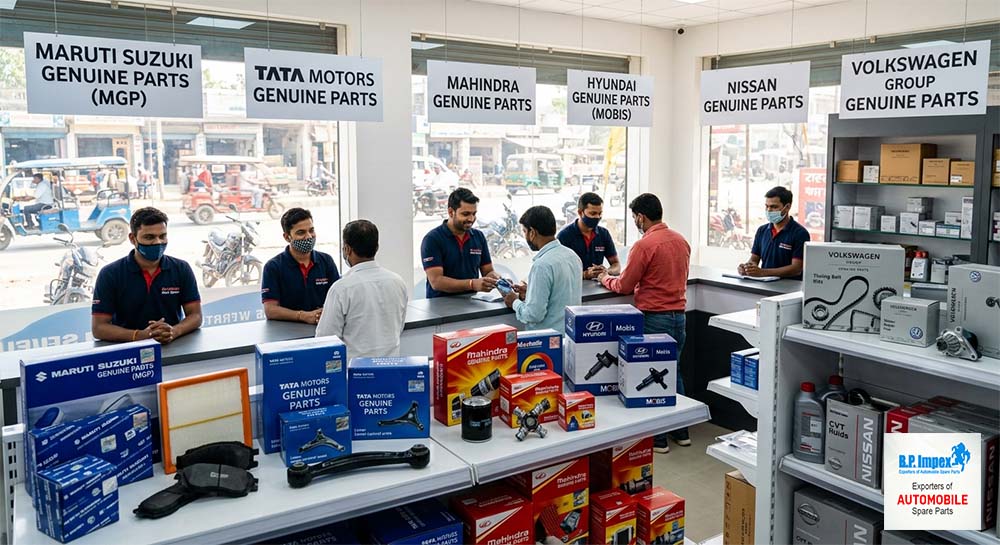
For owners and workshops maintaining compatible Mahindra vehicles, sourcing the correct Mahindra Spare Parts is important, particularly when a vehicle is outside its original warranty period.
But simply searching for a part by vehicle brand is not enough.
The exact:
- Model
- Variant
- Year
- Engine
- Transmission
- Part number
may need to be confirmed before ordering.
Two vehicles from the same manufacturer can look similar while using different components.
Suzuki Spare Parts for Long-Term Vehicle Maintenance
Suzuki has a large presence on Indian roads, which means owners have access to a mature service and parts ecosystem.
Over the life of a vehicle, common replacement requirements can include:
- Oil filters
- Air filters
- Brake components
- Clutch components
- Suspension parts
- Steering components
- Cooling-system parts
- Electrical components
- Engine-related parts
When purchasing Suzuki Spare Parts, the exact vehicle details should be checked before placing an order.
This becomes particularly important when multiple generations or variants share similar names.
A part that looks identical in a photograph may not necessarily have the same specification.
Tata Spare Parts and the Cost of Keeping a Vehicle on the Road
Tata vehicles are used extensively in India’s passenger and commercial vehicle markets.
As mileage increases, owners may require replacement components related to:
- Braking systems
- Suspension
- Steering
- Engine
- Transmission
- Cooling
- Electrical systems
- Body and exterior components
For compatible vehicles, sourcing the right Tata Spare Parts can help owners and workshops maintain vehicles beyond their initial warranty period.
Again, the focus should be on the correct component rather than simply the lowest price.
For customers looking for replacement vehicle components, BP Auto Spares India is a car spare-parts seller and exporter serving customers in India and international markets.
Whether the requirement involves a routine replacement or a specific vehicle component, accurate vehicle details and part identification are important before ordering.
EV Spare Parts Are a Different Story
This is one area where EV ownership differs considerably from conventional vehicles.
An EV still uses many familiar automotive components:
- Brake pads
- Brake discs
- Suspension
- Steering components
- Wheel bearings
- Tyres
- Wipers
- 12V battery
- Air-conditioning components
But the main EV powertrain contains highly specialised components.
These can include:
- High-voltage battery
- Electric motor
- Inverter
- Battery Management System
- On-board charger
- High-voltage wiring
- Power electronics
These are not ordinary workshop components.
A high-voltage system should be diagnosed and repaired by appropriately trained professionals using suitable safety equipment.
This is one reason EV buyers should look closely at the manufacturer’s service network before making a purchase.
Spare-Part Availability Becomes More Important as a Car Ages
A brand-new car under warranty is relatively easy to maintain.
If a component fails, you usually have an authorised service centre available to diagnose and repair it.
But what happens after five, seven or ten years?
That is when owners may start looking for:
- Alternative suppliers
- Independent workshops
- Replacement components
- Older-model parts
- More economical repair options
- Specific part numbers
- Reliable aftermarket sources
Petrol and diesel vehicles currently have an advantage here because their aftermarket ecosystem is much more established.
EVs are still developing their independent repair and replacement-parts ecosystem.
That situation is likely to evolve as the number of EVs on Indian roads increases.
The Five-Year Ownership Test
Let’s compare two hypothetical drivers.
Driver A
Drives a petrol car around 800 km per month.
Driver B
Drives an EV around 2,000 km per month.
Driver B is using the vehicle much more.
Therefore, even a modest saving in energy cost per kilometre can become significant over a year.
But Driver A may have a very predictable maintenance experience because petrol parts, workshops and technicians are widely available.
This illustrates something important:
A vehicle’s technology cannot be separated from the owner’s driving pattern.
The same EV can be financially attractive for one driver and less attractive for another.
Insurance: Another Cost You Shouldn’t Ignore
Fuel and servicing are not the only recurring ownership expenses.
Insurance can also represent a significant amount over several years.
Premiums depend on factors such as:
- Vehicle value
- Model
- Variant
- Location
- Driver profile
- Coverage
- Insurer
- Claim history
- Add-on covers
EV buyers should pay particular attention to battery-related coverage and understand what the policy actually covers.
For petrol and diesel cars, owners should similarly examine coverage for their specific vehicle rather than selecting a policy solely because its premium is lower.
The cheapest policy is not always the most useful policy when you actually need to make a claim.
Depreciation: The Cost You Don’t See on the Dashboard
Here is one of the biggest hidden expenses of car ownership.
Imagine that you buy a vehicle for:
15 lakh
After five years, suppose you sell it for:
8 lakh
You have lost 7 lakh in vehicle value.
That 7 lakh does not appear on your monthly fuel bill.
But financially, it is still a cost.
This is why a vehicle with extremely low running costs is not automatically the cheapest vehicle to own.
A proper comparison should include depreciation.
EV Resale Value and Battery Health
The used-EV market is still developing.
As it grows, buyers are likely to pay increasing attention to battery condition.
Consider two three-year-old EVs.
EV A
- Good battery health
- Warranty remaining
- Complete service records
- No major accident history
EV B
- Noticeably reduced battery capacity
- Little or no battery warranty remaining
- Poor service history
Even if both vehicles look identical from outside, their resale prospects could be very different.
That is why EV owners should keep documentation related to:
- Battery warranty
- Service history
- Battery health
- Charging-system maintenance
- Repairs
- Accident history
Petrol Resale Value
Petrol cars currently have an advantage in terms of familiarity.
Most buyers understand them.
Most mechanics can service them.
Fuel stations are widespread.
Spare parts are widely available.
This creates confidence in the used-car market.
But resale value still depends on:
- Vehicle condition
- Mileage
- Model popularity
- Service history
- Number of owners
- Accident history
- Local demand
So petrol does not automatically guarantee high resale value.
Diesel Resale Value
Diesel resale value can vary significantly depending on the model and location.
A popular diesel SUV with a strong reputation can continue to attract buyers.
At the same time, changing regulations and consumer preferences can influence demand over time.
If resale value is a major priority, research the specific vehicle rather than relying only on the fact that it is diesel-powered.
So, Which One Is Easier to Maintain?
At this point, the picture is becoming clearer.
EV
Routine powertrain maintenance: Low
Engine oil servicing: Not applicable to the traction motor
Mechanical complexity: Lower in the main powertrain
Specialised repair requirement: Higher for high-voltage systems
Spare-parts ecosystem: Still developing
Petrol
Routine maintenance: Moderate
Mechanical complexity: Moderate to high
Service network: Very extensive
Spare-parts availability: Very strong
Diesel
Routine maintenance: Moderate
Mechanical complexity: High in modern systems
Service network: Extensive
Potential major repair cost: Can be high for specialised components
This is why there is no single maintenance winner in every situation.
The EV generally has an advantage in routine powertrain maintenance.
Petrol has an advantage in simplicity of the wider repair ecosystem.
Diesel can deliver excellent durability but requires careful maintenance of its more complex systems.
The Question That Matters More Than “Which Is Cheapest?”
After looking at maintenance, spare parts, insurance and depreciation, we can see why the cheapest car on paper may not be the cheapest car in real life.
A better question is:
“Which car gives me the lowest total cost without creating inconvenience I don’t want?”
Because convenience has a value too.
If you have to drive 30 kilometres to find a charger, wait for charging and change your route regularly, the theoretical fuel savings of an EV may not feel like a saving.
On the other hand, if your EV charges overnight at home while you sleep, charging may become easier than visiting a fuel station.
Similarly, a diesel car may offer excellent highway efficiency, but if you rarely travel outside the city, its advantages may not justify the additional complexity.
And a petrol car may consume more fuel, but its convenience can be worth paying for.
What Should You Look at Before Choosing Your Car?
Before making the final decision, write down these numbers:
1. Monthly Kilometres
How far do you actually drive?
2. City vs Highway
What percentage of your driving happens in each environment?
3. Home Charging
If considering an EV, can you charge at home or at work?
4. Annual Fuel/Energy Cost
How much will you realistically spend?
5. Service Cost
What does the manufacturer’s service schedule cost?
6. Spare Parts
How easily can common replacement components be sourced?
7. Insurance
What will the insurance cost every year?
8. Resale
What is the expected resale demand for the specific model?
9. Warranty
What exactly is covered and for how long?
10. Ownership Period
Are you keeping the car for three years or ten?
That last question can completely change the answer.
The Three-Year Owner vs the Ten-Year Owner
A person planning to sell a car after three years should pay close attention to:
- Depreciation
- Resale value
- Warranty
- Market demand
Someone planning to keep the vehicle for ten years should focus much more on:
- Long-term maintenance
- Spare-parts availability
- Battery or engine durability
- Repair costs
- Service network
- Component availability
This is why two people can look at exactly the same car and make completely different decisions.
Both can be right.
The Maintenance Verdict So Far
After considering all these factors, we can make a reasonable broad comparison.
EVs generally have an advantage in routine powertrain maintenance.
Petrol cars have an advantage in widespread service and spare-parts availability.
Diesel cars can be highly efficient for high-mileage users but may carry greater repair complexity.
But we still haven’t answered one of the biggest practical questions.
What happens when you actually take these cars out of the city?
Because an EV that looks perfect for daily commuting can become a completely different proposition on a 700-kilometre road trip.
And a diesel that feels unnecessary in city traffic can suddenly make a lot more sense on the highway.
That brings us to the next part of the comparison:
city driving, highway driving, charging versus refuelling, long-distance travel and real-world practicality.
And this is where the “best car” may change depending on where you drive.
City vs Highway: Where Does Each Car Make More Sense?
The maintenance question gives us a fairly clear picture, but ownership does not happen inside a service centre.
It happens on the road.
And this is where your daily driving environment can completely change the answer.
A car that makes perfect sense for a daily city commute may not be the ideal choice for someone travelling between cities every weekend.
Likewise, a car that feels unnecessary for short urban trips can become very practical when you regularly cover hundreds of kilometres.
So let’s put EV, petrol and diesel cars into the situations where they will actually be used.
EV vs Petrol vs Diesel for City Driving
For most people, city driving means:
- Frequent traffic
- Short trips
- Stop-and-go movement
- Frequent braking
- Lower average speeds
- Heavy use of air conditioning
- Regular acceleration and deceleration
These conditions can actually suit an electric vehicle very well.
Why EVs Work Well in Cities
Electric motors deliver torque almost instantly.
You don’t have to wait for an engine to build revs or for a gearbox to select the right gear.
The result is smooth and predictable acceleration.
Regenerative braking can also be useful in traffic because energy can be recovered during deceleration.
Another major advantage is silence.
In a crowded city, removing engine noise can make daily driving noticeably more relaxed.
And if you can charge at home overnight, your routine can become extremely simple.
You park the car.
Plug it in.
Go to sleep.
The next morning, you have a charged vehicle ready for the day.
No fuel-station visit is required.
But There Is One Big Question for City EV Buyers
Where will you charge?
This question is more important than many buyers realise.
If you have:
- Dedicated parking
- Home charging
- Reliable electricity
- A predictable daily route
an EV can be extremely convenient.
But if you live in a building where installing a charger is difficult, or you regularly depend on public charging stations, the ownership experience may be different.
Before buying an EV, ask yourself:
“If my battery is low tonight, where will I charge it?”
If the answer is easy, an EV becomes much more attractive.
If the answer requires a complicated plan every time, petrol may still offer greater convenience.
Petrol Cars in the City
Petrol remains one of the safest all-round choices for urban drivers.
Why?
Because there is very little planning involved.
Fuel stations are widely available, refuelling takes only a few minutes and there is no need to think about charging time.
For someone who drives irregularly, petrol can be particularly convenient.
Imagine that you normally drive 20 kilometres a day but suddenly need to make a 300-kilometre trip tomorrow.
With a petrol car, you simply refuel and go.
That flexibility has real value.
Diesel Cars in the City
Diesel cars can certainly be used in cities.
But whether they are the best choice depends on how the vehicle is used.
If your daily routine consists mostly of:
- Very short trips
- Low-speed traffic
- Frequent starts and stops
- Limited highway driving
the advantages of diesel may not be fully utilised.
A diesel engine is generally more attractive when it gets enough long-distance running to justify its efficiency and torque characteristics.
That is why buyers should think about usage rather than reputation.
Don’t buy a diesel simply because someone says it gives better mileage.
Buy it because your driving pattern actually benefits from it.
What About Highway Driving?
Now imagine a completely different situation.
You are planning a 700-kilometre road trip.
You want to stop as little as possible.
You don’t know exactly where you will stop for lunch.
Traffic may be unpredictable.
Weather may change.
You may have passengers and luggage.
This is where petrol and diesel have an obvious convenience advantage.
You can usually find a fuel station, refuel quickly and continue.
An EV can also complete long journeys, but route planning becomes more important.
EV Highway Driving: Better Than Many People Think
Modern EVs can be excellent highway cars.
They can offer:
- Smooth acceleration
- Quiet cruising
- Strong overtaking response
- Comfortable driving
- Reduced energy consumption in some conditions
The challenge is not necessarily the vehicle.
It is the charging network and journey planning.
Before a long EV trip, you may need to consider:
- Starting battery percentage
- Distance to the next charger
- Charger availability
- Charging speed
- Expected traffic
- Weather
- Backup charging locations
- Destination charging
This doesn’t necessarily make EV travel difficult.
It simply makes it different.
Charging vs Refuelling: The Convenience Battle
This is one of the most important differences between the three technologies.
Refuelling a Petrol or Diesel Car
The process is simple.
Drive to a fuel station.
Fill the tank.
Pay.
Leave.
Depending on the queue, the process can take only a few minutes.
The infrastructure is mature and widespread.
Charging an EV
Charging is more variable.
You may charge:
- At home
- At work
- At a public AC charger
- At a public DC fast charger
- At a destination charger
The time required depends on the charging equipment and the vehicle.
Home charging is generally slower than high-power DC charging, but it can be convenient because the vehicle charges while parked.
That changes the way you think about refuelling.
Instead of making a special trip to “refuel,” you can effectively make charging part of your parking routine.
The Biggest EV Advantage May Not Be Speed
Many people compare EV charging with petrol refuelling and conclude that petrol wins because it is faster.
Technically, that is true.
But there is another way to look at it.
A petrol car needs you to visit a fuel station.
An EV can often charge while you are:
- Sleeping
- Working
- Shopping
- Eating
- Parking
If you have reliable home charging, you may rarely need to think about charging at all.
So the real question is not:
“Which one refuels faster?”
It is:
“Which one fits my routine better?”
What Happens in an Emergency?
Imagine you suddenly need to drive much farther than planned.
With petrol or diesel, finding fuel is generally straightforward.
With an EV, you need to know your remaining range and the availability of charging points.
This is one reason petrol remains attractive to buyers who value maximum flexibility.
EVs are improving rapidly, but charging access is still an important part of the ownership equation.
Pros and Cons of Electric Cars
No technology is perfect.
Let’s put the advantages and disadvantages side by side.
Advantages of EVs
Lower Running Cost
Electricity can be cheaper per kilometre than petrol or diesel, particularly when charging at home.
Lower Routine Powertrain Maintenance
There are fewer traditional engine components and no conventional engine-oil servicing.
Instant Torque
Acceleration is smooth and immediate.
Quiet Driving
The driving experience can be significantly quieter.
Regenerative Braking
Some braking energy can be recovered.
Excellent Urban Experience
Stop-and-go traffic can suit the characteristics of an electric drivetrain.
No Tailpipe Exhaust
Battery-electric vehicles do not produce tailpipe exhaust emissions while driving.
Disadvantages of EVs
Higher Initial Price in Some Segments
The purchase price can still be higher than comparable petrol vehicles.
Charging Requires Planning
Especially for long-distance journeys.
Charging Infrastructure Varies
Not every location has the same level of charging availability.
Range Changes With Conditions
Highway speed, weather, air conditioning, load and driving style can affect range.
High-Voltage Repairs Require Expertise
Specialised systems require trained technicians and appropriate equipment.
Battery Health Matters
Buyers need to understand warranty coverage and long-term battery performance.
Pros and Cons of Petrol Cars
Petrol is still one of the most practical choices for many Indian buyers.
Advantages of Petrol Cars
Easy Refuelling
Fuel stations are widespread.
Lower Initial Cost in Many Cases
Petrol variants are often available at competitive prices.
Huge Service Network
Mechanics and workshops are familiar with petrol technology.
Wide Spare-Parts Availability
The mature aftermarket ecosystem makes replacement parts easier to source.
Good for Mixed Usage
Petrol works well for city driving, occasional highway trips and irregular usage.
No Charging Dependency
You don’t need a dedicated charging setup.
Disadvantages of Petrol Cars
Higher Running Cost
Fuel can represent a significant expense over years of high mileage.
Engine Maintenance
Oil, filters, spark plugs and other engine-related components require servicing.
Fuel Price Exposure
Changes in petrol prices directly affect running costs.
Higher Emissions Than EVs
Petrol vehicles produce tailpipe emissions during operation.
Pros and Cons of Diesel Cars
Diesel remains a specialised but useful choice.
Advantages of Diesel Cars
Strong Torque
Diesel engines can provide strong pulling power.
Good Highway Efficiency
They can be efficient during long-distance driving.
Suitable for High Mileage
The economics can work well for people who travel extensively.
Good for Larger Vehicles
SUVs and vehicles carrying heavier loads can benefit from diesel torque.
Disadvantages of Diesel Cars
Higher Initial Cost in Some Models
The diesel variant can cost more than the equivalent petrol version.
More Complex Emissions Systems
Modern diesel engines use sophisticated emissions-control equipment.
Potentially Higher Repair Costs
Components such as turbochargers, injectors and emissions systems can be expensive.
Less Attractive for Short Trips
High-mileage highway usage generally makes a stronger case for diesel.
Five Real-Life Buyers: Which Car Would Make Sense?
Instead of simply declaring a winner, let’s look at five different buyers.
Buyer 1: Daily Office Commuter
Imagine someone travelling:
35 km every day
mostly through city traffic.
They have dedicated parking at home and can install a charger.
For this person, an EV can be extremely attractive.
The vehicle can charge overnight, city driving suits its power delivery and lower energy costs can become meaningful over time.
Best Match: EV
Buyer 2: Family That Drives Occasionally
Now consider a family that drives only:
700–1,000 km per month
with occasional weekend trips.
They don’t have dedicated parking for a charger.
Their annual mileage is relatively moderate.
For this buyer, petrol may be more convenient.
The lower initial price and easy refuelling can outweigh the potential EV running-cost advantage.
Best Match: Petrol
Buyer 3: High-Mileage Highway Driver
Imagine someone driving:
2,500–3,000 km every month
with a large percentage of those kilometres on highways.
Fuel efficiency and long-distance comfort are major priorities.
A diesel vehicle may still make financial and practical sense, depending on the model.
Best Match: Diesel
Buyer 4: Environment-Conscious City Driver
This driver has:
- Home charging
- Predictable daily travel
- Mostly urban driving
- A preference for electric mobility
For this buyer, an EV can offer both practical and personal benefits.
Best Match: EV
Buyer 5: One Car for Everything
This is perhaps the most common buyer.
They want one vehicle that can:
- Handle daily commuting
- Take the family on road trips
- Be easy to refuel
- Require minimal planning
- Remain practical for years
For such a buyer, petrol can remain an extremely sensible option.
An EV can also work if charging infrastructure and travel patterns support it.
Best Match: Petrol or EV, depending on charging access
EV vs Petrol vs Diesel: Five-Year Ownership Example
Let’s create a simplified example.
Suppose three comparable cars cost:
Petrol: 10 lakh
Diesel: 12 lakh
EV: 13 lakh
These are hypothetical numbers only.
Now imagine the owner drives:
18,000 km per year
for five years.
That means:
90,000 km total
Now think about what happens during those 90,000 kilometres.
The petrol car will consume a significant quantity of fuel.
The diesel car will consume less fuel because of its higher efficiency in this example.
The EV will consume electricity instead.
But the calculation doesn’t stop there.
You also need to consider:
- Scheduled service
- Brake wear
- Tyres
- Insurance
- Repairs
- Depreciation
- Financing
- Charging equipment
- Battery warranty
- Resale value
This is why there is no responsible way to declare that:
“EV is always cheapest.”
The result depends on the actual vehicles being compared and the owner’s driving conditions.
A Simple Break-Even Formula
If you want to calculate whether an EV makes financial sense, start with a simple formula.
Step 1: Calculate the Initial Price Difference
EV price – Petrol/Diesel price
Step 2: Calculate Energy Saving Per Kilometre
ICE running cost per km – EV running cost per km
Step 3: Add Maintenance Savings
Estimate the annual maintenance difference.
Step 4: Divide the Initial Difference by Annual Savings
This gives you a rough idea of how long it may take to recover the additional upfront cost.
For example, if an EV costs 2,50,000 more but saves approximately 50,000 per year through energy and maintenance, the simple break-even period would be around five years.
But this is still only an estimate.
Battery health, depreciation, insurance, financing and resale value can change the final result significantly.
What About Environmental Impact?
The environmental discussion is more complicated than simply saying:
EV = clean
and
Petrol/Diesel = dirty.
An EV produces no tailpipe exhaust emissions while driving.
That is a major advantage, especially in urban environments.
However, electricity has to come from somewhere.
The overall environmental impact of an EV also involves:
- Battery manufacturing
- Electricity generation
- Raw-material extraction
- Vehicle manufacturing
- Battery recycling
- End-of-life management
Petrol and diesel vehicles, on the other hand, continuously burn fossil fuels during operation and produce tailpipe emissions.
So EVs should not be described as having zero environmental impact.
A more accurate statement is:
EVs eliminate tailpipe emissions and can reduce overall transport emissions depending on how the electricity and vehicle are produced and used.
What About Government Policies and EV Adoption?
India’s transition toward electric mobility is supported by government initiatives covering areas such as EV adoption, manufacturing and charging infrastructure.
Programmes such as PM E-DRIVE are part of the broader policy push toward electric mobility.
However, buyers should avoid making a purchase decision based entirely on a subsidy.
Government incentives can change over time.
The smarter approach is to calculate whether the vehicle makes sense based on its:
- Purchase price
- Running cost
- Maintenance
- Warranty
- Resale value
- Practicality
If a subsidy applies, consider it an additional benefit rather than the sole reason for buying the vehicle.
Which Car Is Better for Long-Term Ownership?
Now let’s imagine you are planning to keep your vehicle for:
8–10 years.
The decision becomes different.
You need to think about what happens after the initial warranty period.
EV Long-Term Questions
- How will battery health change?
- Is the battery warranty still valid?
- Are replacement components available?
- Is the service network strong?
- Can independent technicians repair the vehicle?
- What will resale demand look like?
Petrol Long-Term Questions
- How much will fuel cost over the ownership period?
- Are replacement parts easily available?
- How much will engine maintenance increase with age?
- What will the resale value be?
Diesel Long-Term Questions
- How will emissions-system maintenance affect cost?
- What happens if the turbocharger or fuel system needs repair?
- How will regulations affect resale?
- Is the vehicle still suitable for your driving pattern?
These questions matter more than simply asking which car has the highest mileage.
The Spare Parts Factor in Long-Term Ownership
The longer you keep a vehicle, the more important spare parts become.
A vehicle that has excellent fuel economy but difficult-to-source components can become frustrating to own.
This is particularly relevant for vehicles that are several years old.
Before buying a car, it is worth checking:
- Availability of routine service parts
- Availability of body parts
- Availability of suspension components
- Availability of electrical parts
- Availability of engine components
- Availability of transmission parts
- Availability of authorised service
- Availability of reliable aftermarket alternatives
For conventional vehicles, the aftermarket ecosystem is generally mature.
For EVs, the ecosystem is developing rapidly but remains more specialised.
For owners and workshops looking for compatible replacement vehicle components, BP Auto Spares India provides car spare parts and export services for customers in India and international markets.
The most important thing when purchasing any replacement component is still the same:
correct identification and compatibility should come before price.
EV vs Petrol vs Diesel: Which One Should You Buy in 2026?
After looking at all these factors, we can finally answer the question.
But the answer is not one word.
Choose an EV If:
- You mainly drive in the city
- You drive regularly
- You have home or workplace charging
- You want lower running costs
- You prefer quiet and smooth performance
- You plan to keep the car for several years
- You are comfortable with charging planning
An EV can be an excellent choice when your daily routine is predictable.
Choose Petrol If:
- You want maximum convenience
- You drive moderate distances
- You don’t have home charging
- You frequently make unpredictable trips
- You want widespread service support
- You prefer quick refuelling
- You want a straightforward ownership experience
Petrol remains one of the strongest all-round choices for a wide range of buyers.
Choose Diesel If:
- You cover high annual kilometres
- Highway driving is frequent
- Strong torque matters
- You regularly carry passengers or luggage
- Long-distance efficiency is important
- You are comfortable with more complex maintenance
Diesel makes the most sense when its strengths match your usage.
The Final EV vs Petrol vs Diesel Scorecard
| Factor | EV | Petrol | Diesel |
| Initial Cost | Can be higher | Often competitive | Can be higher |
| Running Cost | Usually lowest | Usually highest | Often lower than petrol |
| City Driving | Excellent | Very Good | Good |
| Highway Driving | Very Good with planning | Excellent | Excellent |
| Refuelling | Charging required | Very convenient | Very convenient |
| Routine Powertrain Maintenance | Low | Moderate | Moderate/High |
| Spare-Parts Ecosystem | Developing | Excellent | Excellent |
| Acceleration | Instant | Smooth | Strong torque |
| Noise | Very low | Moderate | Higher |
| Long-Distance Planning | More important | Minimal | Minimal |
| Home Infrastructure | Helpful/important | Not required | Not required |
| Battery Concern | Yes | No traction battery | No traction battery |
| Engine Maintenance | Not applicable | Required | Required |
| High Annual Mileage | Very attractive if charging works | Can be expensive | Often attractive |
| Low Annual Mileage | Depends on price difference | Very practical | Often less compelling |
| Best Use | City + predictable charging | Flexible all-round use | High-mileage highway use |
The Most Important Question Before You Buy
Forget the question:
“Which one is best?”
Ask yourself these instead:
How many kilometres do I drive every month?
If the number is low, upfront price and depreciation may matter more.
If the number is high, running cost becomes increasingly important.
Where do I drive?
Mostly city?
Mostly highway?
A mixture of both?
Where will the car be parked?
If you are considering an EV, this question is critical.
Can I charge at home?
If yes, the EV case becomes much stronger.
How long will I keep the car?
Three years?
Five years?
Ten years?
Longer ownership makes running cost and maintenance increasingly important.
What happens if something breaks?
Is the service centre nearby?
Are spare parts available?
Are qualified technicians available?
These questions can tell you more about the right car than a generic comparison chart.
Final Verdict: EV, Petrol or Diesel?
There is no universal winner in the EV vs Petrol vs Diesel debate.
And that is not a disappointing answer.
It is the realistic answer.
An EV is not automatically better because it costs less to run.
A petrol car is not automatically better because it is convenient.
A diesel car is not automatically better because it delivers strong mileage.
Each technology solves a different set of problems.
EV Wins When Your Routine Is Predictable
If you drive mostly in the city, have reliable home charging and want low running and routine maintenance costs, an EV can be one of the smartest choices available in 2026.
Petrol Wins When Convenience Matters Most
If you want a car that can handle almost anything without charging planning, petrol remains extremely practical.
Diesel Wins When You Drive a Lot
If you cover high annual kilometres, spend significant time on highways and value torque and efficiency, diesel can still be a sensible option.
The Best Car Is the One That Fits Your Life
Think about the difference between these two drivers.
One drives 40 kilometres every day, parks at home and charges overnight.
For that person, an EV could be ideal.
Another drives 500 kilometres without warning, frequently travels through areas with limited charging infrastructure and wants to refuel in minutes.
For that person, petrol may be the better choice.
A third driver covers 30,000 kilometres every year, mostly on highways.
For that person, diesel may still deserve serious consideration.
Same country.
Same year.
Three completely different answers.
That is why choosing a car should never be based purely on trends.
Technology matters.
But your lifestyle matters more.
Conclusion
The automotive world is changing quickly in 2026.
Electric vehicles are becoming more capable and more practical. Charging infrastructure is expanding, manufacturers are introducing new models and buyers are becoming more comfortable with electric mobility.
At the same time, petrol cars continue to offer exceptional convenience, while diesel vehicles remain relevant for buyers whose driving patterns make their efficiency and torque valuable.
The smartest way to choose between them is to look beyond the showroom.
Compare the purchase cost, running cost, mileage, performance, maintenance, spare parts, insurance, depreciation, charging or refuelling convenience and expected resale value.
Then match those numbers to the way you actually drive.
If an EV saves you money but charging is inconvenient, it may not be the right choice.
If a petrol car costs less initially but you drive 30,000 kilometres every year, its higher fuel expenditure could become significant.
If a diesel car gives excellent highway mileage but you only use it for short city trips, you may not be taking advantage of its strengths.
The right decision is therefore not about following the latest automotive trend.
It is about understanding your own requirements.
And once you know those requirements, the choice becomes much easier.
EV for efficient, predictable and city-focused driving.
Petrol for flexibility, convenience and straightforward ownership.
Diesel for high-mileage, long-distance and torque-focused driving.
Whichever option you choose, one principle remains the same: regular servicing and quality replacement parts are essential for keeping the vehicle safe, reliable and efficient.
For owners, workshops, distributors and international buyers looking for compatible automotive replacement components, BP Auto Spares India can be considered as a source for car spare parts and export requirements.
Because whether your car runs on electricity, petrol or diesel, good ownership does not end when you buy the vehicle.





Leave a Reply