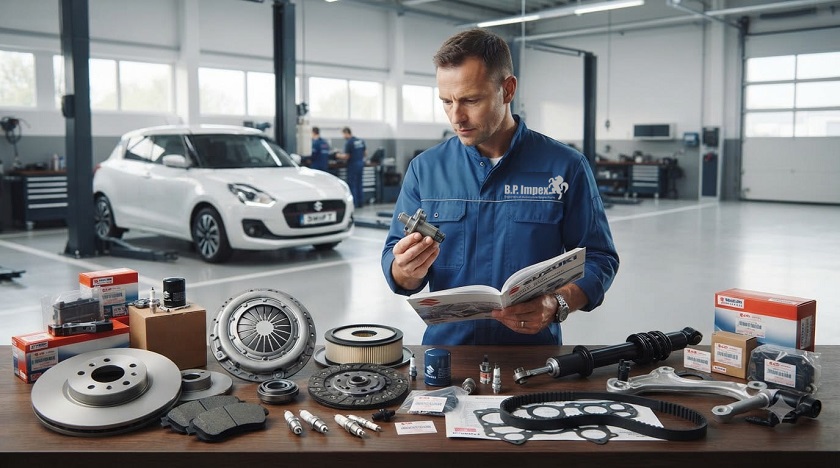
When replacing a component in a Suzuki vehicle, choosing the right part is important for maintaining proper fitment, performance, and reliability. With genuine and aftermarket products often looking similar, it can sometimes be difficult to determine whether a component is authentic. Understanding what to check before purchasing can help buyers avoid incorrect, low-quality, or incompatible parts.
If you are sourcing genuine Suzuki spare parts, there are several practical ways to verify them. Part numbers, packaging, labelling, product specifications, catalogue information, and the credibility of the exporter all provide useful clues. BP Impex helps international buyers source and export Suzuki automotive spare parts according to vehicle and part requirements.
What Are Genuine Suzuki Spare Parts?
Genuine Suzuki spare parts are components manufactured or supplied through the authorised original-equipment ecosystem for Suzuki vehicles. They are designed according to the specifications required for particular Suzuki models and applications.
These parts can include engine components, brake parts, clutch components, suspension parts, electrical components, transmission parts, body components, filters, cooling-system parts, and many other vehicle components.
Unlike generic replacement products, genuine components are associated with specific vehicle applications and part specifications. This makes correct identification particularly important when ordering parts for export or replacement purposes.
Check the Suzuki Part Number
One of the most useful ways to identify a genuine component is by checking its part number. Automotive parts are commonly identified using specific numbers or codes that distinguish one component from another.
Before placing an order, compare the part number with the vehicle’s application, model, variant, engine specification, and production year where applicable. A visually similar part may have a different specification or application.
If you already have the old component, check whether a part number or identification marking is present. However, the number should not be considered independently. It should also be matched against reliable catalogue information.
For international buyers, providing the exact part number to the exporter can make the sourcing process more precise and reduce the possibility of receiving an incompatible component.
Use a Reliable Suzuki Parts Catalogue
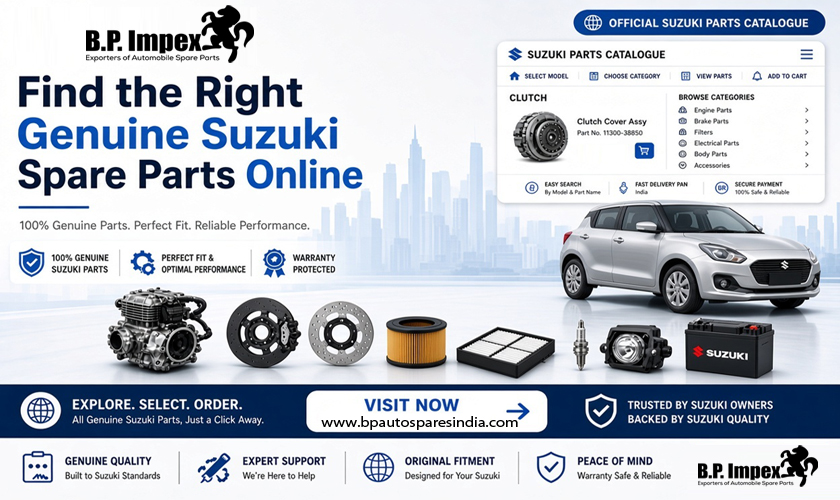
A Suzuki parts catalogue can help buyers identify components according to vehicle models and applications. Catalogue information can provide useful details such as part numbers, component descriptions, assemblies, and vehicle compatibility.
Instead of selecting a part simply because it looks similar to the original component, use catalogue information to verify its application.
For example, Suzuki vehicles may have different versions of the same model depending on the market, engine, transmission, production period, or vehicle configuration. Therefore, checking catalogue information is especially important when sourcing parts internationally.
Examine the Packaging and Labelling
Packaging can provide another indication when checking genuine Suzuki spare parts. Original automotive components are generally supplied with identification information such as product details, part numbers, labels, or packaging markings.
Look carefully for:
- Correct part numbers
- Product descriptions
- Manufacturer or brand information
- Barcode or identification labels
- Packaging quality
- Printing and labelling consistency
Poor-quality printing, spelling mistakes, inconsistent labels, damaged packaging, or suspiciously generic boxes can be warning signs.
However, packaging alone should not be treated as conclusive proof of authenticity. It should be considered together with the part number, application, product details, and source.
Compare the Part With the Original Component
If the replacement is being purchased for an existing vehicle, compare the new component with the original part whenever possible.
Pay attention to dimensions, mounting points, connectors, material, markings, shape, and other physical characteristics. A genuine replacement should correspond to the specifications and application of the original component.
This is particularly important for components such as brake assemblies, clutch parts, electrical components, engine components, sensors, filters, and suspension parts, where small differences can affect compatibility.
A part that appears almost identical may still have different specifications. Therefore, visual comparison should support catalogue and part-number verification rather than replace it.
Verify Vehicle Compatibility
Another important step is confirming that the component is intended for the exact Suzuki vehicle application.
Provide as much information as possible when sourcing a part, including:
- Suzuki model
- Vehicle variant
- Manufacturing year
- Engine type
- Transmission type
- Market or region
- Required component
- Existing part number, if available
For example, a spare part intended for one Suzuki model or engine variant may not necessarily be suitable for another vehicle that has a similar name.
Correct application matching helps reduce ordering errors and supports accurate international sourcing.
Look for Suzuki OEM Spare Parts Information
The term Suzuki OEM spare parts is commonly used when discussing original-equipment specifications and components associated with the vehicle’s original manufacturing requirements.
When sourcing OEM-related components, buyers should verify the actual part number, application, specifications, and documentation rather than relying only on the word “OEM” in a product listing.
A professional exporter should be able to discuss the required part based on identifiable product information. Buyers should be cautious of listings that make broad authenticity claims without providing sufficient details for verification.
Be Careful With Extremely Low Prices
Price can also provide useful context when evaluating a spare part. An unusually low price does not automatically mean that a component is counterfeit, but it is a reason to investigate the product and source more carefully.
Compare the quotation with the part specification, quantity, packaging, shipping requirements, and sourcing conditions.
For international orders, the final cost may also depend on order volume, destination, freight, packaging, and other export-related factors. Therefore, comparing quotations based only on the lowest unit price may not provide a complete picture.
Choose an Experienced Exporter
The source from which you purchase or import automotive components matters. International buyers should look for an exporter that understands automotive parts identification, documentation, packaging, and international shipment requirements.
BP Impex operates as an exporter of automotive spare parts from India and works with international buyers looking to source vehicle components for different markets.
When contacting an exporter, provide detailed information about the required component instead of simply asking for a generic spare part. A part number, model name, catalogue reference, or clear product requirement can help the exporter identify the correct component more efficiently.
Check Product Details Before Confirming an Order
Before finalising an international spare-parts order, review the product information carefully. Confirm that the quotation corresponds to the required component and that the description, part number, quantity, and vehicle application are clear.
If multiple parts are being ordered, maintain a part-number-based list. This can make communication easier and reduce confusion between visually similar components.
For larger export requirements, buyers can also confirm packaging, quantities, shipping terms, and required documentation before shipment.
Why Part Number Accuracy Matters
A part number provides a more precise identification method than a general product name.
For example, simply requesting a “Suzuki brake part” may not provide enough information because a vehicle can contain several brake-related components. Similarly, terms such as engine part, clutch part, electrical part, or suspension part can refer to numerous individual components.
A specific part number helps narrow the requirement and makes communication between the buyer and exporter more accurate.
This is why buyers searching for original Suzuki parts should combine the vehicle information with the relevant part number or catalogue reference whenever available.
Common Mistakes Buyers Should Avoid
One common mistake is assuming that a part is genuine simply because it looks identical to the original. Appearance is useful, but it does not establish authenticity by itself.
Another mistake is purchasing a component solely because it is advertised as “OEM” or “original.” Buyers should check supporting product information and application details.
Choosing a part based only on price can also create problems. A lower-priced component may have different specifications, compatibility, packaging, or sourcing conditions.
Finally, buyers sometimes provide incomplete vehicle information. Model name alone may not be enough to identify the correct replacement. Engine, year, variant, market, and part number can all be relevant.
A Simple Checklist for Identifying Genuine Suzuki Spare Parts
Before purchasing, use this simple checklist:
1. Identify the exact component: Know precisely which part is required.
2. Check the part number: Match the available number with reliable catalogue information.
3. Verify vehicle application: Confirm the model, variant, engine, transmission, and year where applicable.
4. Review packaging: Check labels, markings, product information, and packaging quality.
5. Compare specifications: Look at dimensions, connectors, mounting points, and other relevant details.
6. Check the source: Work with an established automotive exporter or recognised sourcing partner.
7. Review the quotation: Confirm part number, description, quantity, and export details before placing the order.
8. Keep documentation: Maintain records of part numbers and order information for future requirements.
Why Choose BP Impex for Suzuki Spare Parts Export?
BP Impex supports international buyers looking to source and export Suzuki automotive spare parts from India. The company focuses on identifying parts according to customer requirements and relevant vehicle information.
For buyers handling wholesale, replacement, or recurring automotive requirements, providing accurate part numbers and vehicle details can make sourcing more efficient. BP Impex can assist with export-oriented requirements covering different Suzuki vehicle components and applications.
Whether you need engine components, brake parts, clutch parts, electrical components, transmission parts, suspension components, or other automotive replacements, accurate identification should come first.
Final Thoughts
Identifying genuine Suzuki spare parts requires more than checking the appearance of a component. Part numbers, catalogue references, vehicle compatibility, packaging, specifications, and the credibility of the exporter should all be considered before confirming an order.
For international buyers, accurate information is particularly important because an incorrect component can create additional costs, shipping complications, and installation issues. Using a Suzuki parts catalogue, verifying the required part number, and communicating complete vehicle details can make the sourcing process more reliable.
If you are looking to source Suzuki automotive components from India for international markets, BP Impex can support your requirement as an automotive spare-parts exporter. Share the required Suzuki model, component name, part number, or catalogue reference to begin the sourcing process.



Leave a Reply